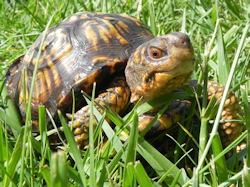
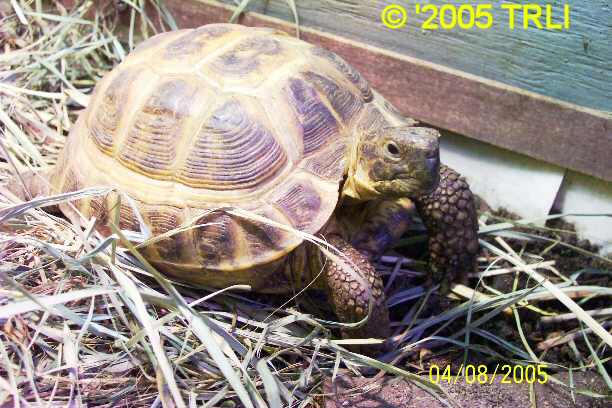
Russian tortoises seem to be
one of the most popular tortoises sold in pet stores. They are
fairly easy to care for and are hardy torts.
If you purchase your
Russian tortoise (RT) from a pet store the first thing you should do
is bring your new tortoise along with a fecal (poop) sample to a
qualified veterinarian who works with reptiles, turtles in
particular, so the tort can be checked over and the fecal checked
for parasites. Most pet store RT’s are recent imports that are wild
caught (WC) and are usually loaded with them. Some will fare well
for a while and then suddenly their appetite and activity level
drops and illness is inevitable. Best to get them checked out and
treated before illness sets in.
These tortoises are shipped
in crates when imported into the states. They are crammed in with no
regard to their health and well-being. This tortuous method of
shipping over stresses these fine torts and this is what brings
parasites and illness, so it’s really important to have them checked
out.
An alternative to buying
from a pet store is to buy a captive bred (CB) tortoise from a
reputable breeder. A CB tortoise may cost you more financially in
the beginning, but over all will save you money in vet bills as they
will arrive to you with a clean bill of health. WC tortoises sell
for between $50 and $90 in most of the pet stores I’ve seen them in
and online for about the same price. A vet visit is on average about
$50, a fecal check about $25 and meds probably another $25 or so. So
your inexpensive WC tortoise just from the get go has cost you at
least $150 or more and its health is questionable.
If you purchase a CB
hatchling they usually sell for anywhere from $150 to $175 and will
arrive healthy and parasite free with minimum stress because even if
shipped they will be shipped individually, not piled in a crate with
hundreds of other torts. So this should all be considered before
purchasing your tortoise.
Set Up:
The larger you can make the
set up for your tortoise the happier and healthier it will be. So do
your best to provide it with as much space as possible.
That being said if you
can’t provide a large habitat you can keep your RT in a large
Rubbermaid type tub (50 gallon or larger) or larger under bed
storage box. Many people build tortoise tables, which can be raised
up and built against a wall, built on table legs, or on the floor.
I’ll provide some links with pictures to give you some ideas.
I find the best substrate
to be a 50/50 mix of play sand and topsoil (no additives like
perlite, just plain dirt) or sand and coir (sold in a brick that you
expand in water). Some brand names are Flukkers, Eco Earth, Bed a
Beast. It’s easy to clean up and if some is ingested it is easily
passed so long as you keep your tortoise well hydrated. I’ve not had
any problems with keeping either my hatchlings or adults on these
mixes. No matter what substrate you use there will be somebody out
there that has something bad to say about it, so you need to work
with what’s best for you and your tortoise. Contrary to what some
will tell you, the substrate should not be kept bone dry. It should
have some moisture to it. Not enough so the torts are getting wet,
but not so dry that it’s dusty either. I usually have to pour water
in the area of the basking lamp every couple of days to keep that
area damp. The lamp dries it up rather quickly. It should be damp
enough so when squeezed it holds together but no drops of water come
out.
The basking area needs to
give them a good warm spot at about 95°F and the other end of their
enclosure should be cool at about 70°. A regular household bulb can
be used for the basking area, but a good UVB lamp
must
be provided. This is critical for a healthy tortoise. There are
fluorescent types and there are also combination bulbs that provide
both heat and uvb.I’ve found the
UV/heat lamps to be
most reliable and cost effective and
provide the best output of both heat and uvb.
Fluorescent bulbs need to be replaced about every six
months because the uvb depletes over time. Avoid the screw in coil
like bulbs as they DO NOT provide sufficient UVB. There are also
quite a few that have caused eye problems in reptiles called photo-kerato-conjunctivitis.
I like the convenience of the combo bulbs since you only need one
fixture over your enclosure. To make life easy and to set a regular
schedule for your tortoise set the lamp on a timer. At night all
lamps should be turned off to let the temperature have a normal drop
like they would have in the wild.
When setting up your
enclosure keep the cost of the fixtures and bulbs in mind. A hood
fixture may cost $20 - $30 or more plus a new bulb about $15 or
more. Then you also need to buy a fixture to hold a heat bulb for
basking, which is about another $10. You may pay $50 for a UV/heat
lamp and another $10 for the domed fixture it goes in, but you get
much better UVB output and you have the simplicity of one fixture
and the bulb lasts longer than six months. If you’re lucky you’ll
have a pet shop or herp society member that owns a solar meter to
check your bulbs output for you.
There is no substitution
that compares to all natural sunlight. If you have a yard and you’re
able to provide a secure outdoor enclosure for your tortoise please
do so. The bigger the better. Plant it with all sorts of edible
plants and weeds, provide a good soaking dish and your RT will be as
happy and healthy as it can possibly be in captivity. Just be sure
to provide a secure enclosure, which includes a good cover, made
with hardware cloth. Not only are predators a threat to RT’s but
also RT’s are amazing escape artists.
Russian tortoise diet
consists of all healthy greens. They need a high fiber, low protein
diet. Never give your RT fruit of any kind except for Cactus pear.
Fruit has the tendency to disrupt the gut flora and cause a parasite
bloom in RT’s. Following is a partial list of good greens for your
tort.
Turnip greens, dandelion,
chicory, endive, escarole, red or green leaf lettuce, radicchio,
romaine, mustard greens, collard greens, watercress and spinach
(high in oxalates, but over all good vitamin content). The key to a
good diet is variety. Although spinach is listed as a bad food on
many sites the other vitamins it contains offset the fact that it’s
high in oxalates. As long as you provide good variety spinach is a
good part of the diet. A whole carrot or broccoli stalk can be given
about once a month. Good for them to chew on and help keep the beak
trim.
Always provide your
tortoise with a water dish large enough to soak in. Change the water
daily and/or if soiled. Often RT’s will use their water dish as a
toilet. If you see a white discharge when your tortoise poops this
is urates. Urates are excess proteins being excreted. As long as
they are coming out looking more like slime they are okay, this
means your tortoise is hydrated. If they begin to get pasty or
gritty the tortoise is dehydrated and should be soaked more often
and also check your substrate to make sure it’s not drying out.
As long as you are
providing your tortoise with a good varied diet and lots of uvb,
supplements aren’t needed. There are excellent dried powders that
can be added to your torts food to ensure they are getting the
vitamins and nutrition they need. TNT, sold exclusively by
www.carolinapetsupply.com
is an all natural supplement that provides great nutrition for your
tortoise including calcium. Since there is no USDA recommended
dosage this is a good way to be sure you are not over-supplementing
because it’s made from a variety of nutritious plants.
RT’s normally hibernate in
the wild so if you do your homework and get the conditions right
your RT can be hibernated. I’ll provide a link below for
instructions. Never hibernate a tortoise you have had for less than
a year, and never hibernate a tortoise that has been ill or is not
in optimum health.
Links:
Tortoise Enclosures:
http://www.russiantortoisepictures.com/gallery2/main.php?g2_itemId=965
http://www.turtlerescues.org/gallery2/main.php?g2_itemId=726
Male / Female & Other
Photos:
Hibernation:
http://www.russiantortoise.net/hibernation_journey_orig.htm
Outdoor heated housing:
http://russiantortoise.org/deck_box.htm
For further information and
detailed care from everything on health to habitat to breeding RT’s
go to
http://www.russiantortoise.org/
There you will find all the information you will ever need on
keeping these wonderful tortoises.
For an excellent source of
supplies for your tortoise with exceptional customer service go to:
http://www.carolinapetsupply.com/catalog/
Be sure to try the Russian tortoise seed mix and the TNT.
Check List:
- Enclosure – NO TANKS – Need open and airy –
Tortoise table preferred (Tortoise Palace or Tortoise House are
great) or large tote 50 gallon + per tortoise
- Lighting – Basking
spot 95°F (35°C) basking spot 70°F (21°C) cool side
- Substrate – 50/50 mix
Coir/Play sand or Plain topsoil (no additives)/Play sand kept
slightly damp
- Water dish with easy
access should be provided – shallow water to cover plastron.
- Provide Cuttlebone for
added calcium and to keep beak trim
- Diet – No pellets –
Dark leafy greens high in fiber, low in protein with double
calcium to phosphorus ratio. No Fruit.
- Soak tortoise once or
twice a week for about 20 minutes in warm water up to carapace
- White excretions when
they poop are called urates. This is normal as long as they are
not real thick or gritty.
|